

What if the most important breakthrough in botanical wellness wasn't a new ingredient at all, but a new way to deliver the ones we already have? That's exactly what nano-technology has done for hemp, and the results are changing how people think about absorption, bioavailability, and what "effective" really means.
Why Size Is Everything
Let's start with a number that puts this in perspective. A single human hair is approximately 80,000 nanometers wide. The particles in traditional hemp products typically measure between 2,000 and 10,000 nanometers. Now here's the critical part: your skin's barrier pores, the tiny openings that allow substances to pass through your epidermis, range from 55 to 100 nanometers in size.
Do the math. Traditional hemp particles are 20 to 180 times larger than the pores they're supposed to pass through. It's like trying to thread a rope through the eye of a needle. Some particles make it through eventually, but most bounce off the surface or get filtered out by the body's natural defense systems. The result? Industry estimates suggest that traditional hemp products achieve only 6 to 10 percent bioavailability. That means 90 to 94 percent of what you're paying for never actually reaches your system.
Nano-technology solves this by reducing particle size to under 100 nanometers, with the most effective formulations achieving particle sizes around 60 nanometers. At that scale, particles don't just fit through skin barrier pores, they pass through mucous membranes and cellular walls with remarkable efficiency. Bioavailability jumps to 30 to 80 percent, a 3 to 8 fold improvement that fundamentally changes the economics and experience of hemp wellness.
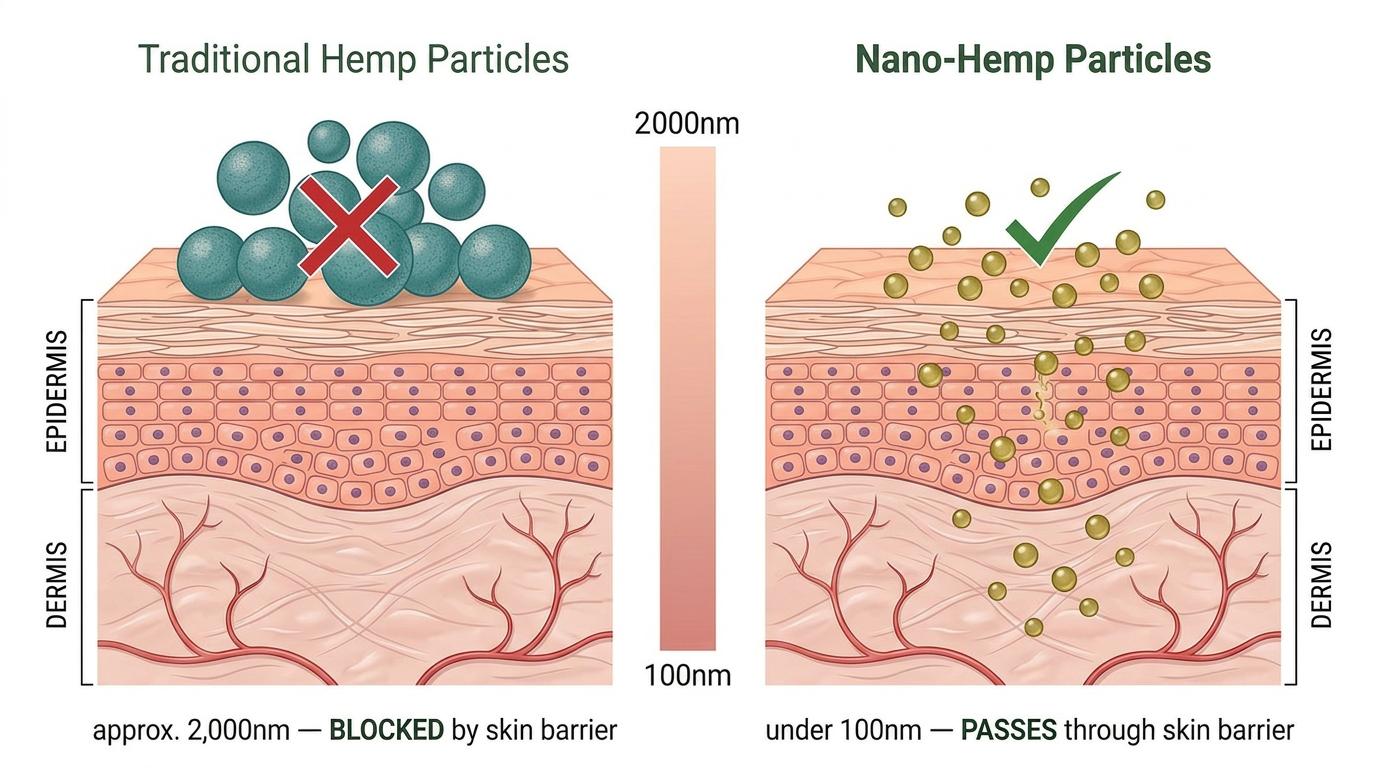
Traditional hemp particles (~2,000nm) are blocked by the skin barrier. Nano-hemp particles (<100nm) pass directly through.
The Science of Fragmentation
Creating particles this small requires more than a blender and good intentions. True nano-fragmentation demands precision engineering at the molecular level. The process involves controlled mechanical and acoustic energy applied to hemp extract in a carefully calibrated environment, breaking down particle clusters into individual nano-spheres without degrading the compounds themselves.
The breakthrough that made commercial nano-hemp viable came from a team of Ivy League PhD researchers at Arkos Bioscience, a West Coast biotech firm that has spent years perfecting the art and science of particle size reduction. Their proprietary fragmentation process achieves consistent particle sizes under 100 nanometers while maintaining compound stability, something that had eluded researchers for decades.
"The challenge wasn't just making particles smaller," explains the research team behind the technology. "It was making them smaller, stable, and consistent, batch after batch, at production scale. Anyone can create nano-particles in a lab. Creating them reliably in a manufacturing environment is an entirely different problem."
Beyond Hemp: The Nano Revolution
What's fascinating about nano-technology is that its applications extend far beyond hemp. The pharmaceutical industry has been using nano-delivery systems for years to improve drug absorption. The cosmetics industry uses nano-carriers to deliver active ingredients deeper into skin. Even the food industry is exploring nano-encapsulation to improve nutrient delivery.
But hemp presents unique challenges. The compounds are lipophilic, meaning they don't naturally mix with water. The human body is approximately 60 percent water. This fundamental incompatibility is why traditional hemp oil struggles with absorption. Nano-fragmentation doesn't just reduce particle size, it effectively bridges the gap between oil-based compounds and water-based biology, creating a hybrid particle that plays well with both.
For those interested in the peer-reviewed research behind this technology, Arkos Bioscience publishes their findings on their website, including studies on particle size distribution, stability testing, and comparative bioavailability data. The science is rigorous, independently verified, and publicly available for anyone who wants to understand exactly how and why this works.
What to Look For in a Nano-Hemp Product
Not all nano-hemp is created equal. The term "nano" gets thrown around loosely in marketing materials, often by companies whose particles are nowhere near 100 nanometers. Here are the questions to ask before you buy:
- Particle Size Data: Does the company provide third-party lab verification of particle size? Look for dynamic light scattering (DLS) analysis confirming particles under 100nm.
- Stability Testing: Do the particles stay nano-sized over the product's shelf life, or do they clump back together over time?
- Batch Consistency: Is every batch tested, or just occasional samples? Consistency matters.
- Ingredient Simplicity: More ingredients doesn't mean better formulation. Our products use just four clean ingredients because the nano-technology is effective enough that nothing else is needed.
The Bottom Line
Nano-technology isn't a buzzword or a marketing gimmick. It's a genuine scientific advancement that delivers measurable, verifiable improvements in how botanical compounds interact with the human body. The research is solid. The data is public. The difference is real.
At Wild Roots Hemp, we chose to build our entire product line around nano-delivery because we believe families deserve the most effective formulation science can provide. We didn't invent the technology, but we did choose to make it the foundation of everything we create.
Explore the Research
Curious about the science behind nano-fragmentation? The research team at Arkos Bioscience continues to push the boundaries of nano-delivery technology. Visit their site to explore peer-reviewed studies, particle size data, and the latest developments in the field.
"The future of botanical wellness isn't about discovering new compounds. It's about delivering the ones we already have more effectively. Nano-technology is how we get there."
Whether you're new to hemp wellness or have been using traditional products for years, the nano difference is worth experiencing. Smaller particles. Better absorption. Faster onset. Fuller benefits. That's not marketing. That's physics.


